
Men’s Yoga Benefits for Flexibility Strength and Stress Relief

Many men first arrive at yoga for one simple reason: something feels tight, sore, restless, or stuck. It might be stiff hips after years of football, a lower back that complains after deadlifts, shoulders rounded from desk work, or a mind that will not switch off at night.
Yoga can help with all of that. It is not a soft option, and it is not reserved for people who can fold themselves in half. A good yoga practice builds mobility, body control, balance, breathing skill, and mental calm. For men who train hard, sit for long hours, play sport, or carry stress in the body, it can be one of the most useful habits to build.
This guide is informational only and is not a substitute for medical advice. If there is pain, injury, dizziness, or a health condition, speak to a qualified health professional before starting.

Yoga meets men where they actually are
A lot of men do not avoid yoga because they dislike movement. They avoid it because it looks unfamiliar.
Traditional gym training often rewards effort you can see: more weight, faster sprints, harder conditioning, bigger numbers. Yoga works differently. It asks for attention, patience, and control. Those skills may look quiet from the outside, but they are demanding.
The value of yoga for men often shows up in everyday ways:
Getting out of bed without feeling locked up
Squatting more comfortably
Rotating better during golf, tennis, cricket, or swimming
Breathing more steadily under pressure
Recovering better between training sessions
Feeling less tense in the neck, jaw, hips, and back
That is why Men’s Yoga Benefits for Flexibility Strength and Stress Relief is more than a neat phrase. It describes the three areas where many men notice change first.
Yoga improves flexibility without forcing the body
Flexibility is the benefit most people expect from yoga, and for good reason. Many poses lengthen muscles that commonly feel tight, especially after sport, lifting, cycling, running, or long periods of sitting.
Men often report tightness in the:
Hamstrings
Hip flexors
Calves
Glutes
Chest
Shoulders
Lower back
This does not mean men are naturally inflexible. It often means the body has adapted to repeated positions. Sit for years, and the hips get used to being bent. Bench press often, and the chest and front shoulders can dominate. Run regularly, and the calves and hip flexors may hold more tension.
Yoga helps by combining gentle stretching with active control. A good pose is not a passive collapse. It teaches the body to breathe while under mild tension, which can make flexibility feel safer and more usable.
For example, a forward fold may stretch the hamstrings, but it also teaches awareness of the lower back and pelvis. A low lunge may open the hip flexors, but it also asks the core and glutes to support the position. Over time, this creates mobility you can use, not just range you can force.
A useful rule for beginners is simple: stretch to sensation, not pain. A strong pull is fine. Sharpness, tingling, numbness, or joint pain is a sign to back off.
Yoga builds strength in ways the gym may miss
Yoga is not only stretching. Try holding a slow plank, a controlled warrior pose, or a steady chair pose, and that myth disappears quickly.
Yoga develops strength through bodyweight resistance, balance, and time under tension. It often targets smaller stabilising muscles that do not always get enough attention in standard gym routines.
This can help with:
Core strength
Shoulder stability
Hip control
Grip and wrist resilience
Balance
Posture
Single-leg strength
Unlike some training styles, yoga rarely isolates one muscle. It asks the whole body to work together. In a pose such as downward-facing dog, the shoulders, arms, spine, hamstrings, calves, and core all play a role. In warrior II, the legs work hard while the upper body learns to stay relaxed.
This kind of strength matters outside the studio. It helps when changing direction in sport, carrying awkward objects, bracing during lifts, or simply moving with less stiffness.
Yoga also exposes imbalances. One side may rotate better. One hip may feel tighter. One shoulder may tire sooner. That feedback is useful. It gives a clear map of what needs attention before small restrictions become bigger problems.

Yoga supports stress relief by training the nervous system
Stress can live in the body long after the stressful moment has passed. Tight shoulders, clenched jaw, shallow breathing, disturbed sleep, and a racing mind are common signs.
Yoga helps because it pairs movement with breath. Slower breathing, longer exhales, and mindful attention can signal safety to the nervous system. Research suggests practices such as yoga, breathwork, and meditation may support stress reduction and emotional wellbeing, especially when practised regularly.
This does not mean one class fixes everything. The benefit comes from repetition.
During yoga, the aim is not to empty the mind. That can frustrate beginners. A better aim is to notice when the mind wanders and gently return to the breath or the body. That small act, repeated again and again, builds mental steadiness.
For men who are used to pushing through stress, this can feel unfamiliar at first. Resting in child’s pose or lying still at the end of class may feel harder than the physical poses. That is part of the training. Learning to downshift is a skill.
Good stress-relief poses include:
Child’s pose
Legs up the wall
Supine twist
Seated forward fold
Reclined butterfly
Savasana, also called corpse pose
Practise them after work, after training, or before bed. Even ten minutes can change the tone of the evening.
Common misconceptions keep many men away
The biggest barrier to starting yoga is often not the poses. It is the story people carry about what yoga is.
You do not need to be flexible before you start
Saying you need flexibility before yoga is like saying you need strength before going to the gym. Flexibility is one of the outcomes, not the entry requirement.
A beginner who cannot touch his toes is not failing. He is exactly where many people begin.
Yoga is not only for women
Yoga is practised by people of all genders, ages, body types, and fitness levels. Many male athletes, martial artists, runners, cyclists, and lifters use it to support performance and recovery.
A class may look different from a weight room, but that does not make it less valuable.
Yoga can be physically challenging
Some styles are gentle. Others are demanding. Power yoga, vinyasa, ashtanga-inspired classes, and hot yoga can all feel intense. Even slower classes can challenge strength and mobility when poses are held with control.
The right class depends on the goal. For recovery, choose slow or beginner yoga. For conditioning, try a more active style later.
Yoga is not a religion requirement
Yoga has deep historical and philosophical roots. Modern classes vary widely. Many focus mainly on movement, breath, mobility, and relaxation. No one has to adopt beliefs they do not hold to benefit from the practice.
Yoga can improve athletic performance
Most sports need more than raw strength. They need range of motion, control, reaction, balance, breathing, and recovery. Yoga supports all of these.
For runners, yoga can help address tight calves, hip flexors, and hamstrings. It may also improve balance and body awareness, which can support steadier form.
For lifters, yoga can improve squat depth, shoulder mobility, bracing awareness, and recovery between sessions. Better thoracic mobility can make overhead positions feel less restricted.
For football, rugby, tennis, golf, and cricket, rotation matters. Poses that open the hips, lengthen the side body, and improve spinal rotation can support smoother movement.
For cyclists, yoga can counter long periods in a flexed position. Chest openers, hip flexor stretches, and gentle backbends can feel especially useful.
The performance benefit is not magic. It comes from helping the body move well and recover better. A tighter body often wastes energy. A more mobile, stable body can use force more efficiently.
Beginner-friendly poses for men
Start with simple poses that build confidence. There is no need for headstands, deep backbends, or advanced arm balances.
Pose | What it helps | Beginner tip |
Child’s pose | Back, hips, breathing | Place a cushion under the chest if the hips feel tight |
Cat-cow | Spine, shoulders, breath | Move slowly and match each movement with an inhale or exhale |
Downward-facing dog | Hamstrings, calves, shoulders | Bend the knees to keep the back long |
Low lunge | Hip flexors, thighs | Use blocks or books under the hands |
Warrior II | Legs, hips, stamina | Keep the front knee tracking over the toes |
Bridge pose | Glutes, spine, chest | Press through the heels and avoid over-arching the lower back |
Supine twist | Spine, ribs, relaxation | Keep the twist gentle and breathe into the ribs |
Legs up the wall | Recovery, stress relief | Stay for three to five minutes and let the breath slow |
A good first session might look like this:
Cat-cow for one minute
Downward-facing dog for five slow breaths
Low lunge on each side for five breaths
Warrior II on each side for five breaths
Bridge pose for five slow repetitions
Supine twist on each side for one minute
Legs up the wall for three minutes
That is enough. A beginner practice should leave the body feeling clearer, not crushed.
How to start without feeling out of place
Starting yoga is easier when the goal is small and realistic. Three short sessions each week can do more than one intense class followed by a month off.
Try these practical steps.
Choose the right class
Look for beginner, slow flow, mobility, restorative, or fundamentals classes. If joining a studio, tell the teacher you are new. A good teacher will offer options.
Use props early
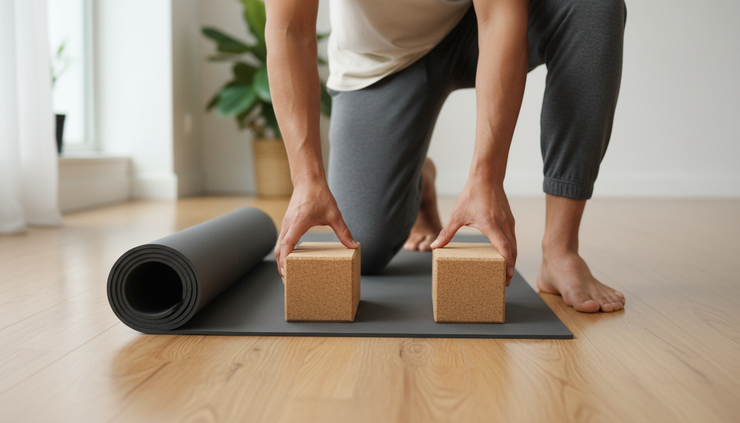
Blocks, straps, cushions, and folded blankets are not signs of weakness. They help the body learn the shape of a pose without strain.
Wear simple kit
A T-shirt and shorts or joggers are fine. Choose clothing that allows movement and does not need constant adjusting.
Do not compete with the room
Yoga is not a race. Someone else’s range of motion says nothing about the quality of your practice. Focus on steady breathing and safe alignment.
Build a home routine
A ten-minute evening routine can be a strong start. Repeat the same few poses for a month. Familiarity makes it easier to notice progress.
Respect pain
Muscle stretch is normal. Joint pain is not. Come out of any pose that causes sharp pain, pins and needles, or numbness.
Stories from men who gave yoga a proper chance
The following are composite examples based on common experiences men report when starting yoga. Names are changed, and the details are illustrative rather than medical case studies.
Mark found his squat felt easier
Mark, 38, lifted weights four times a week but always struggled with squat depth. His ankles and hips felt tight, and his lower back often took over.
He added two short yoga sessions each week, focusing on low lunges, downward-facing dog, deep breathing, and gentle hip openers. After several weeks, he noticed he could sit into a squat with less effort. He did not stop lifting. Yoga made his lifting feel more controlled.
“I thought yoga would be too easy. The first class showed me I had strength, but not much control at end range.”
Imran used yoga to manage work stress
Imran, 45, started yoga after realising he was carrying stress in his shoulders and jaw. He did not want a high-intensity class. He wanted something that helped him sleep.
He began with twenty minutes of slow yoga three nights a week. His routine included child’s pose, cat-cow, supine twists, and legs up the wall. The biggest change was not dramatic flexibility. It was how quickly his breathing settled after a long day.
“I used to treat rest like wasted time. Yoga made rest feel like training for my nervous system.”
Tom improved recovery from running
Tom, 31, ran regularly and kept getting tight calves and hamstrings. He added yoga after easy runs, keeping it short and simple.
He used bent-knee downward dog, low lunges, and gentle forward folds. His legs still worked hard, but he felt less stiff the next morning. The routine also helped him notice when he was pushing too much.
“Yoga gave me feedback. If my hips felt like concrete, I knew I needed an easier run.”

A simple way to make yoga stick
The best yoga practice is the one that fits real life. Start with less than you think you should do. Make it easy to repeat.
For the first month, aim for:
Ten to twenty minutes per session
Two to three sessions per week
The same six to eight poses
Slow breathing through the nose where possible
No pressure to be good at it
Track practical wins rather than dramatic milestones. Notice whether the back feels less stiff in the morning. Notice whether it is easier to breathe during stress. Notice whether training recovery improves. Notice whether sitting, squatting, running, or lifting feels smoother.
Those small changes are the point.
Yoga does not ask men to give up strength, sport, or intensity. It gives the body another tool: mobility with control, effort with breath, and recovery with purpose. Roll out a mat, choose a few basic poses, and give the practice enough time to speak for itself.


Comments